Decisions are made by those who show up

June 16, 2015 10:30 am

The article “Inside Obama’s Stealth Startup” was published yesterday over at fastcompany.com.  It discusses the U.S. Digital Service as well as 18F and the effort to bring government tech into the 21st century.  When these stories post I oftentimes take a look at the comment threads on common tech watering holes like Slashdot and HackerNews.  Generally speaking, Slashdot comment threads are rather cynical while HackerNews tends to be more optimistic, but overall it provides some kind of view into how the greater tech world is responding.  So I was surprised at the amount of cynicism expressed in the comments on HackerNews on this article.

Now, I tend to be fairly cynical, the only negative remark on my annual performance appraisals has always been that I should try to be less cynical.  (Personally, I think my cynicism has helped make our team successful, but I digress…) While I may be somewhat cynical, I’m also on the inside of government work.  I know my team members and their skills.  I know the mission space my software is used in.  And I know my background and motivations.

I understand feeling that nothing in government could really be improved so this whole thing must be nothing more than a PR campaign.  It’s not.  This is possibly the first genuine attempt at meaningfully improving government tech services ever.  And there are more people pushing for it than just those in the U.S.D.S. or 18F.

I’m reminded of a quote from The West Wing: “Decisions are made by those who show up.”

The government isn’t just another corporation out to make a profit.  It is the thing which makes our country more than some lines on a map.  If it’s not working the way you want it to then you have two choices: whine and complain on the Internet about how broken it is or show up and do something about it.

torbakhopper via Flickr - Creative Commons Licensed
torbakhopper via Flickr – Creative Commons Licensed

The government is likely to continue to exist for some time to come*.  If we’re not trying to make it better then it’s not going to get better.  If you know me well you know I am not Mr. Patriotic, and in fact I find patriotism dangerous as it is often used to stifle dissent.  This isn’t about being patriotic or that somehow the U.S. is better than other countries.  This is about the U.S. government being our government.  And it was created upon the idea that the citizens should have some say in how their government operates.

For years technology in government has fallen behind due to thousands of qualified techies deciding they would rather chase piles of money by selling ads and shiny, metal gadgets than trying to make the government better.  And I get that it’s not just about the money. Fighting bureaucracy is hard and exhausting.

But if we don’t fight it then it’s only going to get worse.  And we can change it.  I have changed my small corner of it.

When I started in my job 6 years ago the source code for this group was stored in an ancient deployment of SVN, the applications were built on homegrown J2EE frameworks with no documentation, missing source code, years behind industry best practices, and with release cycles measured in months.  The code was like spaghetti, it barely functioned, and the intended users hated it.  They disliked it so much that they continued throwing their data into Excel to avoid using the custom software which was supposed to be more useful than Excel.  There was no reason for it but culture and lack of energy to fight for change.

When I joined, the existing software group had disbanded.  I still haven’t gotten a full story about what happened, but on my first day on the job the “team” consisted of myself, a database administrator, and a team manager.  Seeing the catastrophe of code that was in front of me I pushed on the manager to let me build a prototype using a modern framework (what did we have to lose, after all?).  It was a smash success and that prototype grew to become one of our core applications.

Now, with the help of willing managers and with our tiny team of software developers (just me, then 2, then 4, now ~7) we’ve made massive changes.  We use Git for our version control, we build our applications on popular open-source frameworks and libraries, we follow industry best practices as much as possible, our release cycles are measured in weeks and sometimes days.  Our users love the software and constantly ask for more advanced tools.  Our management estimates our technology environment to be at least a year ahead of any other organization in our mission space, we have saved the government millions of dollars, and we have saved lives.

Fighting the bureaucracy is hard.  Some days you think it would just be easier to give in.  It would be easier to give in.  But then nothing gets better.

We have enough work to keep a team twice our size busy but we can’t find qualified people to fill the positions.  If the qualified people choose money over service then government technology will continue to suffer.

Our government is what we make of it and the decisions are made by those who show up.

So show up.
Camping

June 13, 2015 8:29 pm

Heather has been asking to go camping for several weeks, but while I was still in class there was no way it was going to happen.  So once that wrapped up I decided to stop putting it off and pick a date.  So I took the afternoon off on Friday, and Heather and I packed up the car, and then sat in traffic… (Jess and Corinne stayed home.)

I wanted to get on the road by 1:00-1:30, but inevitably it took longer.  We were driving by 2:30 which I thought would still be alright, but no.  It was stop-and-go, bumper-to-bumper traffic from Livermore out the other side of Stockton.  That drive should normally take like 40 minutes, but it was over an hour and a half.  Then we had another hour of driving to do on top of that.  Heather fell asleep, which was good given the amount of sleep she was likely to get in the tent.

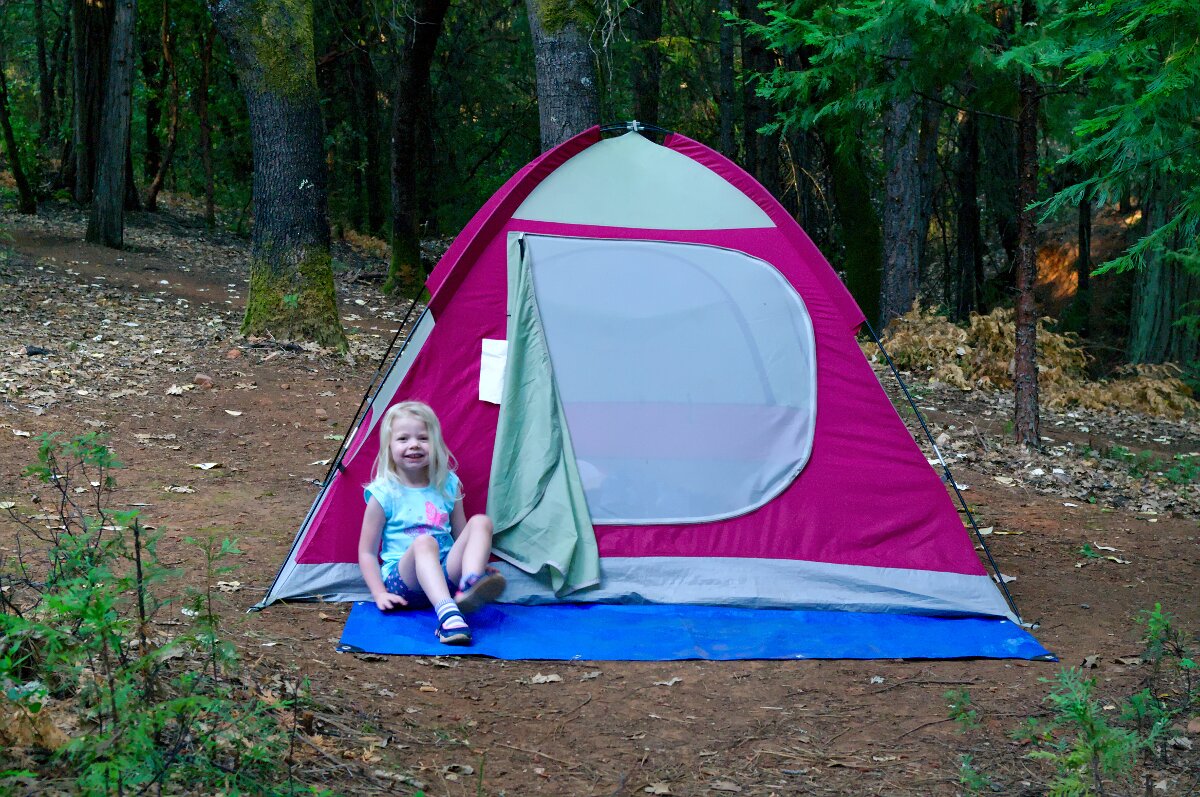
IMGP3040as

We drove out to Indian Grinding Rock State Historic Park.  I liked it when I was there last year–quiet, secluded, trees, and shade.  Presumably there are comparable locations closer to home, but I couldn’t figure out how to find them.

We got to the campground, picked out a spot and got our stuff unpacked.  Then we wandered about looking at the bark houses and grinding rocks.  The high for the day was in the upper 90’s and we probably should have rescheduled, but that’s tough to do with a 3-year-old whose heart is set on the adventure.  Once it cooled down a bit we got our fire going and roasted our hotdogs for dinner.

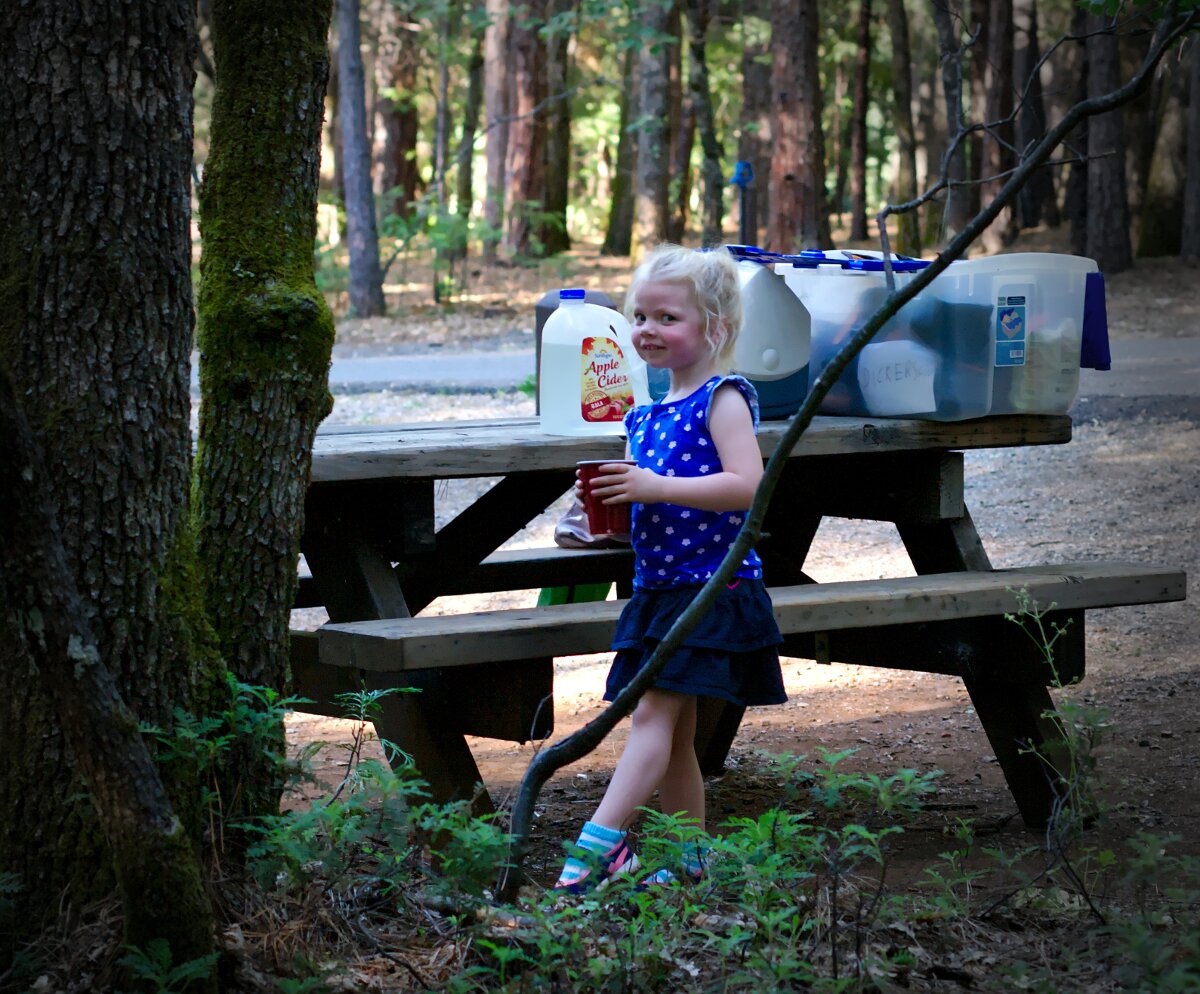
IMGP3120as

Once dinner was cleaned up it was time for s’mores.  I had neglected to put the chocolate bars in the cooler.  But it wasn’t a total loss, I bought the “fun size” chocolate bars which are still salvageable after becoming bags of liquid chocolate.

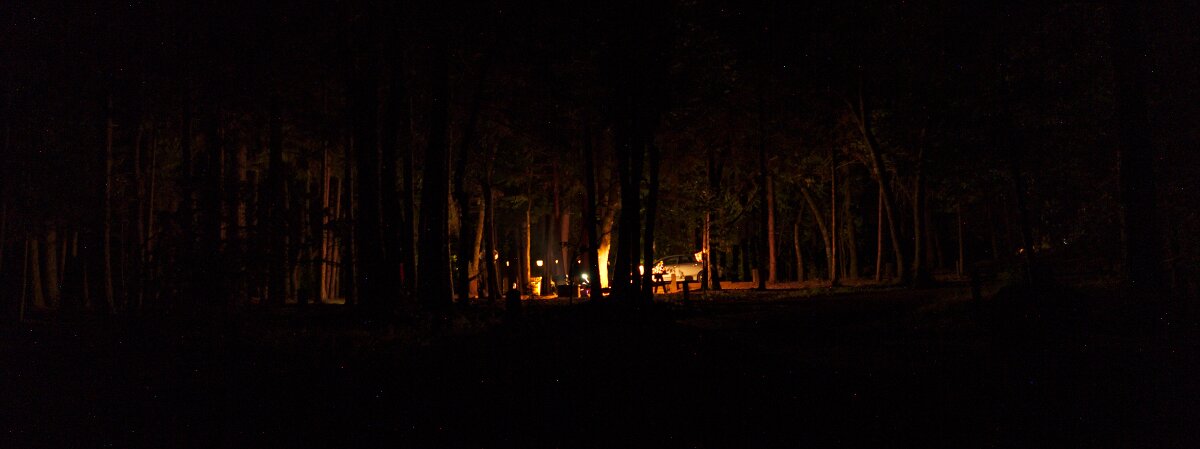
After Heather was asleep I played with the camera for a bit.  Couldn’t get any usable pictures of the stars, but I got this really fun picture of one of the neighboring campsites:

IMGP3086asI really like the light hitting the trees.  And a picture of the fire:

IMGP3098as

In the morning we had breakfast of Silly Circles (off-brand Fruit Loops) at like 5:30 AM since that’s when Heather decided that it was too light out to sleep.  Then we went for a hike and back to the bark houses and grinding rocks while it was still cool and shady.  After that it was time to pack up and head home.

Heather fell asleep, but I woke her up for lunch at A&W.  She was excited to discover they have mini corndogs and milk, her favorite meal.  Then we stopped at the Ghirardelli chocolate outlet and ice-cream shop in Lathrop for an ice-cream sundae.

IMG_20150613_104148as

Heather declared it, “The best camping trip ever,” so I guess it was a success.  I think we avoided sunburn and heatstroke with only mild sleep deprivation.

It occurred to me that I could set up the camera on the tripod to take pictures automatically so we’d have some pictures of the both of us camping.  Then I thought about turning them into a little video.  So enjoy the 4-minute abridged version of the trip with more music and less heat (sadly, I didn’t take the camera with us hiking or to the historical sites).

If your browser doesn’t want to play the video you can download it here: Camping June 12-13 2015 (small)

Audio credits, in order of use:
The end of the last adventure” by soundtrackmusic.org – Creative Commons Licensed
Chimney Fire” by reinsamba – Creative Commons Licensed
Calm Sky” by [SMJ] Music – Creative Commons Licensed
Ocarina – Sun’s Song” by ZREO – Creative Commons Licensed
Call to Adventure” by KevinMacLeod – Creative Commons Licensed

Achievement Unlocked

June 10, 2015 4:56 pm

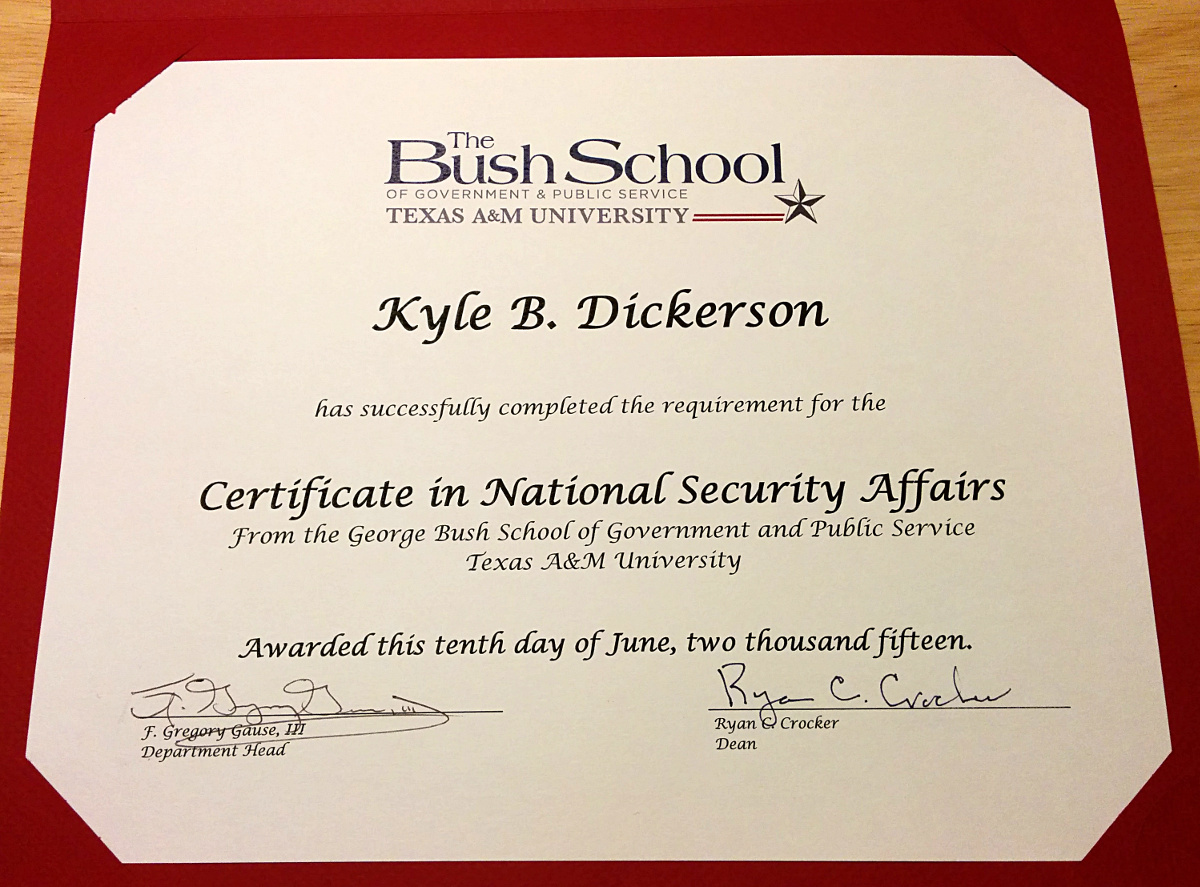
We had our little graduation ceremony today for the National Security Leadership Program that I’ve been participating in over the last year.  The result is being awarded a Certificate in National Security Affairs.

IMG_20150610_162951sWe got to meet with the Lab’s Deputy Director for Science and Technology, Patricia Falcone, who handed out the certificates.  She came to the Lab just a few months ago from the Office of Science and Technology Policy at the White House.  She knows Mike!

The certificate program consists of four graduate courses: Deterrence and Coercion (focusing on nuclear weapons), The Role of Intelligence in Security Affairs (focusing on intelligence agencies and operations), Terrorism in Today’s World, and National Security Policy (history, structure, application of U.S. national security organizations).

It was definitely a different way of looking at the world and a very different way of writing papers.  A lot of time the papers I wrote I felt ended up being a bit hand-wavy, but then I’m used to writing papers where you have hard data with which to argue your point.

I have no idea what will come of my having participated in this program, but it was a good experience.  I enjoyed being back in a class room setting to really focus on interesting topics and at the same time I’m really glad I’m not a full-time student anymore.  It was really nice to be able to intelligently and maturely discuss controversial topics of national policy in a setting that doesn’t devolve into name calling or logically defunct arguments.

Having been through it, I kind of wish passing these courses was a minimum requirement for any politician elected to a national office.

Spammers ruin everything

June 8, 2015 4:18 pm

I’ve been forced to disable comments for older posts because there has been a spammer or spambot sitting on the site submitting garbage comments about every 10 minutes since Friday.

I’d prefer to not make you answer CAPTCHAs in order to post comments, but parasites like spammers ruin everything that isn’t locked down.

For now, older comments will be disabled (comments on current posts are still available though).

Software Wine-Tasting

2:14 pm

In the software world there is a term, “dogfooding,” (shortened from “eating your own dog food”) which describes the act of a team / company using the very software they build–usually as a critical part of their daily work.

That is, if you’re the GMail team and you want to produce the best GMail service you can, you want your software developers, designers, managers, etc. all using GMail on a daily basis.  This will expose them to rough edges that need to be improved and the raw exposure will hasten the work to fix issues.  It also serves to show confidence in the product.  You might be suspicious of the quality of GMail if you heard that all the people that work on the product use something else.

This is all well and good for the kind of software that your own team can use on a daily basis.  But what if your software isn’t an email client, or an instant messenger, or a music player?  The software I spend my time building is not software that I have any reason to use.  The customers/users are a specialized group of people.

I was having a technical discussion today with a group of software developers on this subject.  We recognized that dogfooding our software didn’t make any sense in our environment, but it did make sense to sit down with our users and observe how they use the software and what seems to be confusing or slowing them down.  I described this process as “wine-tasting.”  We’re not consuming the product, we merely sample it in small quantities to try and understand it better.

So there you have it: if you can’t dogfood your software, you should at least by wine-tasting it.